Sample Curriculum – Online

Art & Science of Interactive Games

I make online learning as interactive and engaging as possible. For example, I use H5P content in all of my online courses:
I also regularly host optional Zoom meetings for students where they can discuss class content with their peers, and have face-to-face time with me.

Below is an example of some of the content for Week 2 of my fully online, asynchronous course Art & Science of Interactive Games. The full syllabus for this course can be found here.

Here is the week at a glance:

I always begin with a brief introduction of topics that will be covered in the week.

This week, we are going to spend some time with three concepts within game design that are very important to understand: interactivity, affordances, and representation. These are fairly abstract concepts, but bear with me -- starting next week, we will dig in to how games are made, starting with the building blocks of all games. However, I think it's useful for us to understand interactivity, affordances, and representation because these overarching big concepts will inform and contextualize the rest of the concepts we'll explore this semester. 

As always, if you have any questions, please don't hesitate to reach out! I'm here for you!
Next, students begin the first topic. In this case, we are discussing interactivity and affordances. They read a little text, and then watch the lecture video. A transcript is available for download to ensure accessibility for all students.
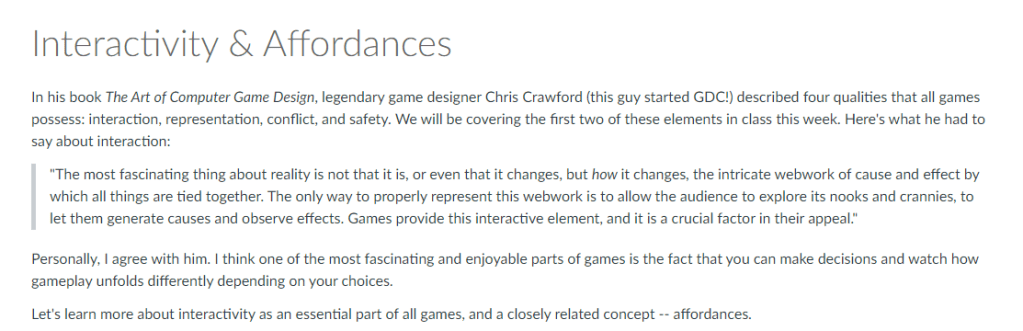
In his book The Art of Computer Game Design, legendary game designer Chris Crawford (this guy started GDC!) described four qualities that all games possess: interaction, representation, conflict, and safety. We will be covering the first two of these elements in class this week. Here's what he had to say about interaction:

"The most fascinating thing about reality is not that it is, or even that it changes, but how it changes, the intricate webwork of cause and effect by which all things are tied together. The only way to properly represent this webwork is to allow the audience to explore its nooks and crannies, to let them generate causes and observe effects. Games provide this interactive element, and it is a crucial factor in their appeal."
Personally, I agree with him. I think one of the most fascinating and enjoyable parts of games is the fact that you can make decisions and watch how gameplay unfolds differently depending on your choices. 

Let's learn more about interactivity as an essential part of all games, and a closely related concept -- affordances.
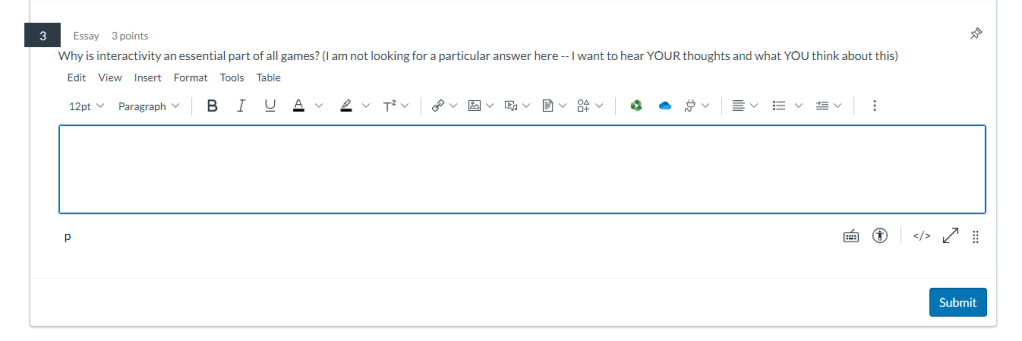
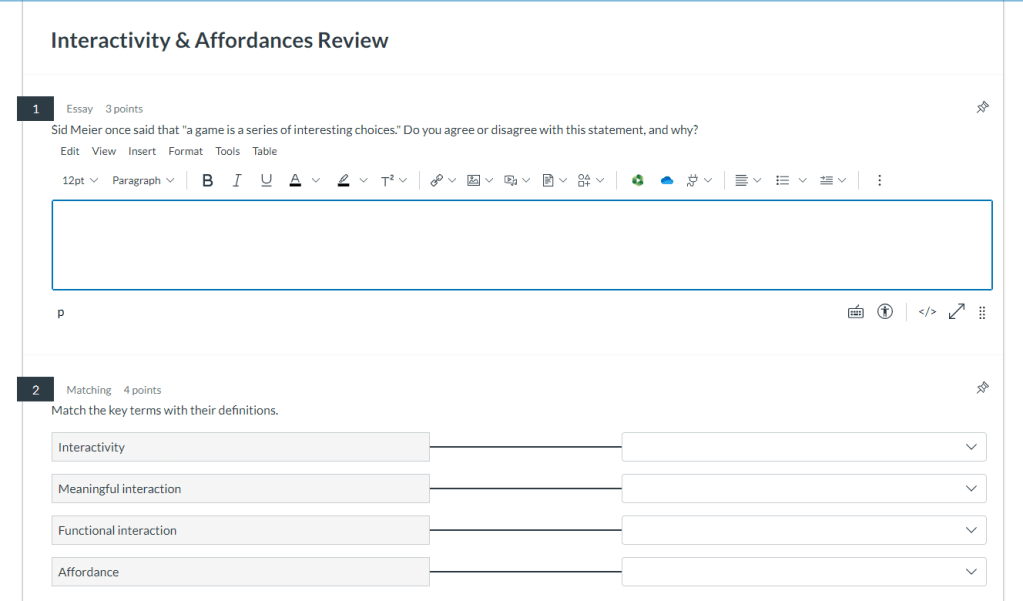
Then, students review the material with a quiz. These quizzes are not timed and can be re-attempted as many times as the student would like. I do not ever use tests in my classes.
For the next topic, students go through an H5P lesson on representation. You can view the transcript of this lesson here.
After they finish with my lecture on representation, they watch another short video about Stuart Hall.
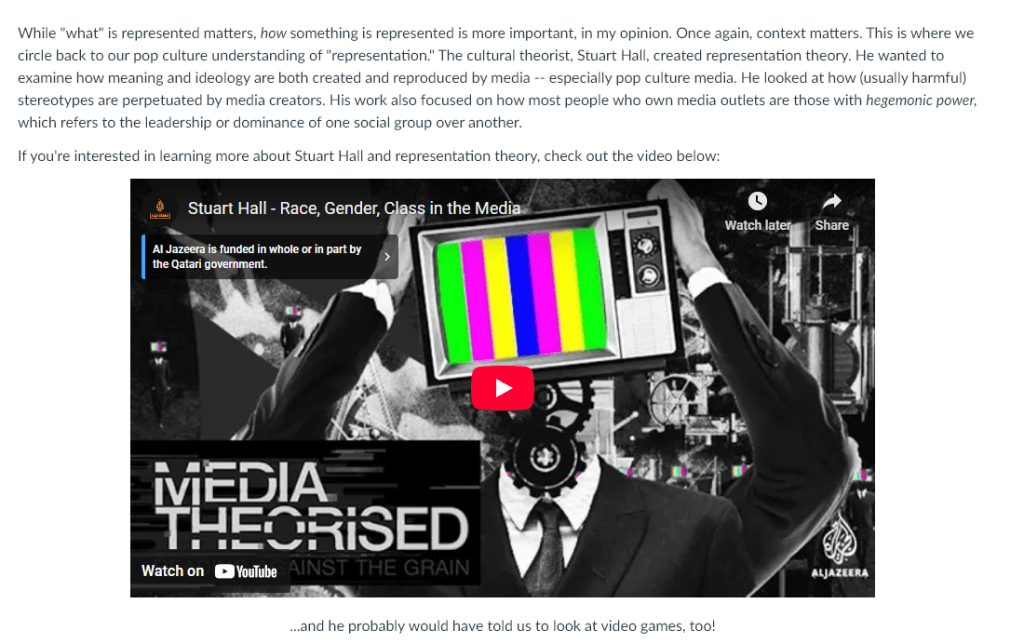
While "what" is represented matters, how something is represented is more important, in my opinion. Once again, context matters. This is where we circle back to our pop culture understanding of "representation." The cultural theorist, Stuart Hall, created representation theory. He wanted to examine how meaning and ideology are both created and reproduced by media -- especially pop culture media. He looked at how (usually harmful) stereotypes are perpetuated by media creators. His work also focused on how most people who own media outlets are those with hegemonic power, which refers to the leadership or dominance of one social group over another.
If you're interested in learning more about Stuart Hall and representation theory, check out the video below:
To put what they’ve learned about interaction and representation into practice, they place Space Invaders and apply the week’s topics. This is done in a discussion forum, so they can view their classmates’ answers and learn from them.
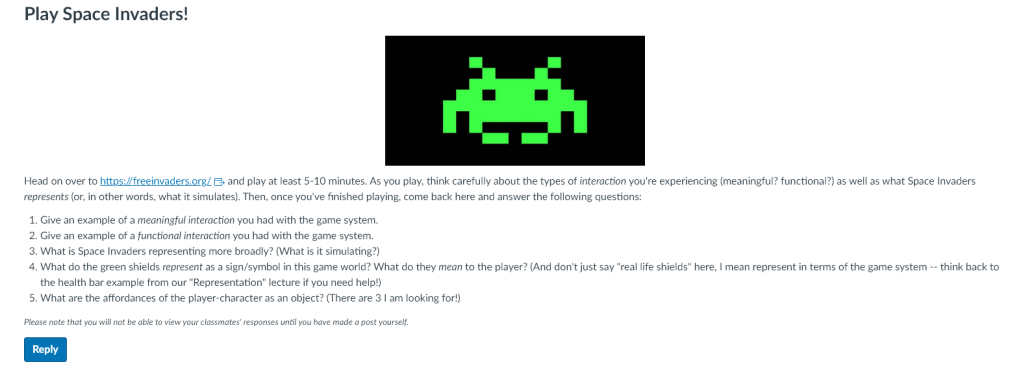
Head on over to https://freeinvaders.org/Links to an external site. and play at least 5-10 minutes. As you play, think carefully about the types of interaction you're experiencing (meaningful? functional?) as well as what Space Invaders represents (or, in other words, what it simulates). Then, once you've finished playing, come back here and answer the following questions:

Give an example of a meaningful interaction you had with the game system.
Give an example of a functional interaction you had with the game system.
What is Space Invaders representing more broadly? (What is it simulating?)
What do the green shields represent as a sign/symbol in this game world? What do they mean to the player? (And don't just say "real life shields" here, I mean represent in terms of the game system -- think back to the health bar example from our "Representation" lecture if you need help!)
What are the affordances of the player-character as an object? (There are 3 I am looking for!)
Please note that you will not be able to view your classmates' responses until you have made a post yourself.
This concludes the new content for the week. Their final task (under Topic 3) is to share their notes and thoughts about the assigned games in the discussion forum. This assignment serves a dual purpose: first, it allows me to ensure that they are steadily progressing through the assigned games. Second, it gives them an opportunity to see what their peers think about the games, too!